
 English
 français
 Deutsch
 русский
 italiano
 日本語
日本語 Türkçe
 Tiếng việt
 Indonesia
Puede ponerse en contacto con nosotros de cualquier manera que sea conveniente para usted. Estamos disponibles 24/7 a través de correo electrónico o teléfono.
Contáctenos
Automatic Lubrication System in Forging Automation: Process, Key Considerations and Best Practices
Why Lubrication Matters in Forging Automation
In modern forging production, lubrication is often underestimated.
However, lubrication quality has a direct impact on die life, forging surface quality, process stability, and production consistency.
As forging lines move toward higher automation levels, manual or semi-automatic lubrication can no longer meet the requirements for precision, repeatability, and cycle-time stability. This is where automatic lubrication systems become a critical part of forging automation.
Typical Problems with Traditional Lubrication
In many forging shops, lubrication is still performed manually or with simple spray devices. Common issues include:
These problems directly limit the stability of automated forging lines.
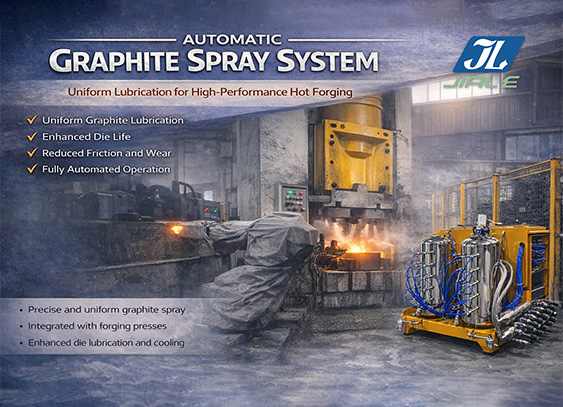
How an Automatic Lubrication System Works
A well-designed automatic lubrication system typically follows a structured and controlled process:
1. Lubricant Preparation
Graphite-based or water-based lubricant is automatically mixed and agitated to maintain stable concentration and prevent sedimentation.
2. Precise Dosing
The lubricant quantity is accurately controlled for each spray cycle, ensuring repeatable results and reducing waste.
3. Efficient Atomization and Spraying
High-quality atomization ensures uniform coverage of die cavities and critical forming surfaces.
4. Synchronization with Forging Automation
The lubrication process is fully synchronized with presses, robots, or manipulators to maintain stable cycle times.
5. Automatic Cleaning and Maintenance
Automatic nozzle cleaning and anti-clogging design minimize downtime and maintenance requirements.
Key Considerations When Selecting an Automatic Lubrication System
When evaluating an automatic lubrication system for forging applications, the following factors are essential:
A lubrication system should not be judged only by its spray function, but by its contribution to overall process stability.
Our Approach to Automatic Lubrication in Forging Automation
Based on extensive experience with forging automation lines, our automatic lubrication systems are designed with a strong focus on:
The goal is not simply lubrication, but process control and consistency.
Conclusion
In forging automation, lubrication is no longer a standalone operation.
It is an integral part of the production process that directly affects quality, efficiency, and die life.
A reliable automatic lubrication system helps forging companies achieve stable production, reduced costs, and higher automation levels.



 IPv6 compatible con la red